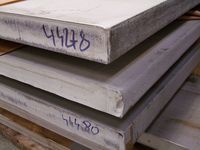
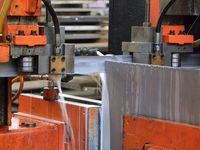
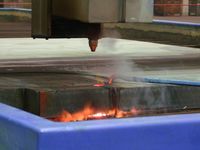
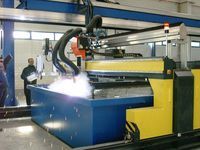
CUTTING TO SIZE AND TRADING
OF STAINLESS STEEL QUARTO PLATES
INTRODUCTION TO STAINLESS STEEL
Stainless steels can be defined as ferrous alloys that contain more than 11% chromium and are resistant to general rusting in mild atmospheric conditions. To be classified in the stainless category, a steel must contain at least 10.5% chromium and less than 1.2% carbon (standard EN 10020). There are different grades and surface finishes of stainless steel to suit the environment to which the material will be subjected in its lifetime. Stainless steel differs from carbon steel by the amount of chromium present. Carbon steel rusts when exposed to air and moisture. This iron oxide film (the rust) is active and accelerates corrosion by forming more iron oxide. Stainless steels have sufficient amounts of chromium present so that a passive film of chromium oxide forms which prevents further surface corrosion and blocks corrosion from spreading into the metal's internal structure.
THE DEVELOPMENT OF STAINLESS STEEL
The inventor of stainless steel, Harry Brearley, was born in Sheffield, England in 1871. His father was a steel melter, and after a childhood of considerable hardship, he left school at the age of twelve to get a job washing bottles in a chemical laboratory. By years of private study and night school he became an expert in the analysis of steel and its production. Having already established his reputation for solving metallurgical problems, Brearley was given the opportunity in 1908 to set up the Brown Firth Laboratories, which was financed by the two leading Sheffield steel companies of the day. This was a highly innovative idea for its time; research for its own sake on the problems of steel making. In 1912 Brearley was asked to help in the problems being encountered by a small arms manufacturer, whereby the internal diameter of rifle barrels was eroding away too quickly because of the action of heating and discharge gases. Brearley was therefore looking for a steel with better resistance to erosion, not corrosion. As a line of investigation he decided to experiment with steels containing chromium, as these were known to have a higher melting point than ordinary steels. Chromium steels were already at that time being used for valves in aero engines. Iron has an atomic weight of 56, chromium 52, so chromium steel valves are lighter than their carbon steel counterparts, another reason why they were adopted so quickly by the emerging aircraft industry. Using first the crucible process, and then more successfully an electric furnace, a number of different melts of 6 to 15% chromium with varying carbon contents were made. The first true stainless steel was melted on the 13th August 1913. It contained 0.24% carbon and 12.8% chromium. Brearley at this time was still trying to find a more wear-resistant steel, and in order to examine the grain structure of the steel he needed to etch (attack with acid) samples before examining them under the microscope. The etching re-agents he used were based on nitric acid, and he found that this new steel strongly resisted chemical attack. He then exposed samples to vinegar and other food acids such as lemon juice and found the same result. At the time table cutlery was silver or nickel plated. Cutting knives were of carbon steel which had to thoroughly washed and dried after use, and even then rust stains would have to be rubbed off using carborundum stones. Brearley immediately saw how this new steel could revolutionise the cutlery industry, then one of the biggest employers in Sheffield, but he had great difficulty convincing his more conservative employers. On his own initiative, he had knives made at a local cutler's, R.F. Mosley. To begin with, Brearley referred to his invention as "rustless steel". It was Ernest Stuart, the cutlery manager of Mosley's who first referred to the new knives as "stainless" after in experiments he had failed to stain them with vinegar. "Corrosion resisting " steel would be really the better term, as ordinary stainless steels do suffer corrosion in the long term in hostile environments. Other claims have been made for the first invention of stainless steel, based upon published experimental papers that indicated the passive layer corrosion resistance of chromium steel or patented steels with a 9% chromium content intended for engineering purposes. Brearley's contribution was that having come to a conclusion by purely empirical means he immediately seized on the practical uses of the new material. Within a year of Brearley's discovery, Krupp in Germany were experimenting by adding nickel to the melt. Brearley's steel could only be supplied in the hardened and tempered condition; the Krupp steel was more resistant to acids, was softer and more ductile and therefore easier to work. There is no doubt that but for Brearley's chance discovery, the metallurgists at Krupp would have soon made the discovery themselves. From these two inventions, just before the First World War, were to develop the "400" series of martensitic and "300" series of austenitic stainless steels. The First World War largely put a halt to the development of stainless steel, but in the early 1920s a whole variety of chromium and nickel combinations were tried including 20/6, 17/7 and 15/11. Brearley fell out with his employers regarding the patent rights to his invention of stainless steel, and he left to join another Sheffield company, Brown Bayleys. His successor at the Brown Firth Laboratories was Dr W. H. Hatfield, who is credited with the invention in 1924 of 18/8 stainless steel (18% chromium, 8% nickel) which, with various additions, still dominates the melting of stainless steel today. Dr Hatfield also invented 18/8 stainless with titanium added, now known as 321. Most of the standard grades still in use today were invented in the period 1913 to 1935, in Britain, Germany, America and France. Once these standard grades became accepted, the emphasis changed to finding cheaper, mass-production methods, and popularising the use of stainless steel as a concept. This tended to stifle the development of new grades. However, after the Second World War, new grades with a better weight-to-strength ratio were required for jet aircraft, which led to the development of the precipitation hardening grades such as 17:4 precipitation hardening. From the 1970s onwards the duplex stainless steels began to be developed. These have far greater corrosion resistance and strength than the grades developed in the 1920s and are really the future for the increasing use of stainless steel.
TYPES OF STAINLESS STEEL
From both the technical and standardization viewpoints, stainless steels are classified according to their metallurgical structure –linked to the type and quantity of the various alloying elements– into four main families. A fifth family –heat-resisting stainless steels- refers to steels used at high temperature, irrespective of their metallurgical structure.
- Martensitic and precipitation hardening stainless steels
- Ferritic stainless steels
- Austenitic stainless steels
- Duplex (austeno-ferritic) stainless steels
- Heat-resisting stainless steels
Martensitic and precipitation hardening stainless steels
These steels generally contain 12 to 19% chromium, and their carbon content varies from 0,08 to 1,2%. They may contain nickel and molybdenum as well as certain alloy additions such as copper, titanium or vanadium. These steels combine good corrosion resistance with mechanical properties equivalent to those of top-of-the-range non-stainless steel alloys. These properties are obtained following the appropriate heat treatment: quenching and tempering for martensitic steels, quenching and ageing and/or thermomechanical treatment for precipitation hardening steels.
Ex:
-Martensitic steels: 1.4021 (X20Cr13); 1.4034 (X46Cr13); 1.4029 (X29CrS13)
-Precipitation hardening steels: 1.4542 (X5CrNiCuNb16-4); 1.4568 (X7CrNiAl17-7)
Ferritic stainless steels
These are Iron-Chromium or Iron-Chromium-Molybdenum alloys whose chromium content varies from 10,5 to 28% and whose carbon content does not exceed 0,08%. These steels generally contain no nickel. They are ferromagnetic, and contrary to popular belief, the fact that this steel family is ferromagnetic by no means implies poor corrosion resistance! Certain ferritic grades have corrosion-resistant properties that are comparable or even superior to those of the most common austenitic steels.
Ex:
- 1.4016 (X6Cr17); 1.4113 (X6CrMo17-1); 1.4510 (X3CrTi17)
Austenitic stainless steels
These stainless steels are by far the most well-known and widely used: in addition to a minimum chromium content of roughly 17%, they contain nickel (usually 7% and more) and possibly additions of molybdenum, titanium, niobium, etc. Their tensile mechanical properties are usually average, but for certain grades can be considerably improved through cold hardening. On the other hand they are highly recommanded for cryogenic applications, due to their lack of fragility at low temperatures.
Ex:
- 1.4307 (X2CrNi18-9); 1.4404 (X2CrNiMo17-12-2)
Duplex (austeno-ferritic) stainless steels
These steels are characterised by high chromium contents (22% and more) and relatively low nickel contents (3,5 to 8%). A special feature of these steels is their dual-phase structure (austenite + ferrite) at ambient temperature, and their austenite content ranges from 40 to 60% depending on the grade. Their tensile mechanical properties are higher than those of the austenitic steels (approximately 1,2 times for tensile strength and 2 times for yield strength). They can also be cold hardened. Their corrosion resistance is generally higher than that of austenitic steels, especially in respect of generalised corrosion and stress corrosion.
Ex:
- 1.4462 (X2CrNiMoN22-5-3)
Heat-resisting stainless steels
Although all stainless steels can cover a certain range of high temperatures, depending on their composition, the term „refractory” is often used for highly alloyed grades suitable for working temperatures between 900 and 1150°C (Standard EN 10095).
Ex:
- 1.4841 (X18CrNiSi25-21); 1.4845 (X8CrNi25-21)
STAINLESS STEEL: THE EUROPEAN STANDARDS
The European standard EN 10088 is the main standard concerning „general purpose” stainless steels. This standard provides for two designations:
Symbolic designation
According to the standard EN 10027 „Designation system for steels”, the symbolic designation for stainless steels starts with the letter „X”, representing steels containing at least one alloying element whose content is equal to or greater than 5%. This letter is followed by the carbon content x100, and then by the chemical symbols of the alloying elements, by decreasing order of their content. The average contents of these elements are then indicated, separated by dashes, in the same decreasing order:
X12Cr13 – X2CrNiMo17-12-2
Numerical designation
It contains five digits and starts with 1.4; the third digit corresponds to a particular family of grades and takes into account the chemical composition, while the last two are assigned arbitrarily.
1.40xx: Stainless steel with Ni% < 2,5 –without Mo, Nb or Ti
1.41xx: Stainless steel with Ni% < 2,5 –with Mo, without Nb or Ti
1.43xx: Stainless steel with Ni% > 2,5 –without Mo, Nb or Ti
1.44xx: Stainless steel with Ni% > 2,5 –with Mo, without Nb or Ti
1.45xx: Stainless steel containing special additions
Examples: 1.4003 – 1.4404 – 1.4301 – 1.4006
ALLOYING ELEMENTS
The large family of stainless steels –with a wealth of over 200 grades- also employs alloying elements other than chromium depending on the properties sought, to improve corrosion resistance, mechanical properties or working conditions.
Manganese: Increases strength and hardness; forms a carbide; increases hardenability; lowers the transformation temperature range. When in sufficient quantity produces an austenitic steel; always present in a steel to some extent because it is used as a deoxidiser
Silicon: Strengthens ferrite and raises the transformation temperature temperatures; has a strong graphitising tendency. Always present to some extent, because it is used with manganese as a deoxidiser
Chromium: Increases strength and hardness; forms hard and stable carbides. It raises the transformation temperature significantly when its content exceeds 12%. Increases hardenability; amounts in excess of 12%, render steel stainless. Good creep strength at high temperature.
Nickel: Strengthens steel; lowers its transformation temperature range; increases hardenability, and improves resistance to fatigue. Strong graphite forming tendency; stabilizes austenite when in sufficient quantity. Creates fine grains and gives good toughness.
Nickel and Chromium: Used together for austenitic stainless steels; each element counteracts disadvantages of the other.
Tungsten: Forms hard and stable carbides; raises the transformation temperature range, and tempering temperatures. Hardened tungsten steels resist tempering up to 6000C
Molybdenum: Strong carbide forming element, and also improves high temperature creep resistance; reduces temper-brittleness in Ni-Cr steels. Improves corrosion resistance and temper brittleness.
Vanadium: Strong carbide forming element; has a scavenging action and produces clean, inclusion free steels. Can cause re-heat cracking when added to chrome molly steels.
Titanium: Strong carbide forming element. Not used on its own, but added as a carbide stabiliser to some austenitic stainless steels.
Phosphorus: Increases strength and hardnability, reduces ductility and toughness. Increases machineability and corrosion resistance
Sulphur: Reduces toughness and strength and also weldabilty. Sulphur inclusions, which are normally present, are taken into solution near the fusion temperature of the weld. On cooling sulphides and remaining sulphur precipitate out and tend to segregate to the grain boundaries as liquid films, thus weakening them considerably. Such steel is referred to as burned. Manganese breaks up these films into globules of maganese sulphide; maganese to sulphur ratio > 20:1, higher carbon and/or high heat input during welding > 30:1, to reduce extent of burning.
HEAT TREATMENT
Heat treatment is a method used to alter the physical, and sometimes chemical, properties of a material. The most common application is metallurgical. Heat treatments are also used in the manufacture of many other materials, such as glass. Heat treatment involves the use of heating or chilling, normally to extreme temperatures, to achieve a desired result such as hardening or softening of a material. Heat treatment techniques include annealing, case hardening, precipitation strengthening, tempering and quenching. It is noteworthy that while the term heat treatment applies only to processes where the heating and cooling are done for the specific purpose of altering properties intentionally, heating and cooling often occur incidentally during other manufacturing processes such as hot forming or welding.
Annealing, in metallurgy and materials science, is a heat treatment wherein a material is altered, causing changes in its properties such as strength and hardness. It is a process that produces conditions by heating to above the re-crystallization temperature and maintaining a suitable temperature, and then cooling. Annealing is used to induce ductility, soften material, relieve internal stresses, refine the structure by making it homogeneous, and improve cold working properties.
Case hardening or surface hardening is the process of hardening the surface of a metal, often a low carbon steel, by infusing elements into the material's surface, forming a thin layer of a harder alloy. Case hardening is usually done after the part in question has been formed into its final shape, but can also be done to increase the hardening element content of bars to be used in a pattern welding or similar process.
Precipitation hardening, also called age hardening or dispersion hardening, is a heat treatment technique used to increase the yield strength of malleable materials, including most structural alloys of aluminium, magnesium, nickel and titanium, and some stainless steels. It relies on changes in solid solubility with temperature to produce fine particles of an impurity phase, which impede the movement of dislocations, or defects in a crystal's lattice. Since dislocations are often the dominant carriers of plasticity, this serves to harden the material. The impurities play the same role as the particle substances in particle-reinforced composite materials. Just as the formation of ice in air can produce clouds, snow, or hail, depending upon the thermal history of a given portion of the atmosphere, precipitation in solids can produce many different sizes of particles, which have radically different properties. Unlike ordinary tempering, alloys must be kept at elevated temperature for hours to allow precipitation to take place. This time delay is called aging.
Note that two different heat treatments involving precipitates can alter the strength of a material: solution heat treating and precipitation heat treating. Solution heat treating involves formation of a single-phase solid solution via quenching and leaves a material softer. Precipitation heat treating involves the addition of impurity particles to increase a material's strength. Precipitation hardening via precipitation heat treatment is the main topic of discussion in this article.
Tempering is a heat treatment technique for metals, alloys and glass. In steels, tempering is done to "toughen" the metal by transforming brittle martensite into bainite or a combination of ferrite and cementite. Precipitation hardening alloys, like many grades of aluminum and superalloys, are tempered to precipitate intermetallic particles which strengthen the metal. Tempering is accomplished by a controlled reheating of the work piece to a temperature below its lower critical temperature.
The brittle martensite becomes strong and ductile after it is tempered. Carbon atoms were trapped in the austenite when it was rapidly cooled, typically by oil or water quenching, forming the martensite. The martensite becomes strong after being tempered because when reheated, the microstructure can rearrange and the carbon atoms can diffuse out of the distorted BCT structure. After the carbon diffuses, the result is nearly pure ferrite.
In metallurgy, there is always a tradeoff between strength and ductility. This delicate balance highlights many of the subtleties inherent to the tempering process. Precise control of time and temperature during the tempering process are critical to achieve a metal with well balanced mechanical properties
A quench refers to a rapid cooling. In polymer chemistry and materials science, quenching is used to prevent low-temperature processes such as phase transformations from occurring by only providing a narrow window of time in which the reaction is both thermodynamically favorable and kinetically accessible. For instance, it can reduce crystallinity and thereby increase toughness of both alloys and plastics (produced through polymerization).
In metallurgy, it is most commonly used to harden steel by introducing martensite, in which case the steel must be rapidly cooled through its eutectoid point, the temperature at which austenite becomes unstable. In steel alloyed with metals such as nickel and manganese, the eutectoid temperature becomes much lower, but the kinetic barriers to phase transformation remain the same. This allows quenching to start at a lower temperature, making the process much easier. High speed steel also has added tungsten, which serves to raise kinetic barriers and give the illusion that the material has been cooled more rapidly than it really has. Even cooling such alloys slowly in air has most of the desired effects of quenching.
Extremely rapid cooling can prevent the formation of all crystal structure, resulting in amorphous metal or "metallic glass".
MAIN ISSUES
On the assumption that prevention is better than cure, this short article addresses these issues. The causes of disappointment can arise at any point in the long supply chain that often applies to a stainless steel project. This helps to explain why problems occur. Getting the appropriate knowledge to all parts of the supply chain is difficult and it only takes ignorance in one small part to create a problem later on. The main issues are:
1.Importance of surface finish in determining corrosion resistance
Lack of knowledge in this area is a major cause of problems. Most specifiers and designers understand the importance of selecting a grade of stainless steel, for example 1.4301 (304) or 1.4401 (316). But surface finish is at least as important. Briefly, a bright polished surface gives maximum corrosion resistance.
A directional polish equivalent to the EN 10088-2 2K (Ra = 0.5 micron max), usually produced using SiC abrasives, will give adequate corrosion resistance in many severe environments notably heavy urban and coastal ones. A common surface finish achieved with 240 grit alumina abrasives has been implicated in the corrosion of stainless steel in urban and coastal environments. In some cases, surface roughness Ra values have been measured at well above 1 micron which is known to be inadequate in these environments. The lack of any specified surface finish on architectural drawings can be the source of the final problem.
If, at any stage of the supply chain, there is any doubt about the appropriate surface finish, specialist advice should be sought.
2.Importance of post-fabrication treatments
Apart from some specialised processes, welds in stainless steel always result in some degree of heat tint. Heat tint is essentially an oxidised surface which has a reduced corrosion resistance compared to the parent material. Therefore, the normal practice is to carry out some form of post weld treatment to improve the corrosion resistance. Good fabrication practice always includes post weld treatment. Failure to do so can give rise to unnecessary cost of rectification later on.
3.Importance of segregating carbon and stainless steel
Sometimes "rusting" of stainless steel turns out to be nothing of the kind. It is the rusting of carbon steel which has contaminated the surface of the stainless steel at some point in the production process. Possible sources of contamination from carbon steel include:
Tools
Lifting Gear, Ropes, Chains
Grinding dust
Cutting sparks
Wire brushes
Wherever possible, stainless steel and carbon steel should be fabricated in separate areas of the workshop or better still in separate workshops. Where not possible it is important to clean down machines used for carbon steel beofre using them for stainless steel. Stainless steel surfaces should be protected with plastic coatings for as long as possible.
4. Importance of site management
It is quite possible for everything to be done well in fabrication, only for the whole project to be spoiled by inappropriate practices on site. The issues outlined in 3. apply just as much to the site installation as anywhere else in the process. In addition, it must be remembered that what is appropriate for one building material is totally unacceptable for another. For stainless steel it has to remembered that masonry and brick cleaners may contain hydrochloric acid sometimes called muriatic acid. If these fluids are to be used at all near stainless steel, care should be taken to protect the stainless steel surfaces. If splashes occur, they should be immediately washed off with water. Failure to do so will result in serious attack of the stainless steel resulting in expensive rectification costs
5.Importance of choosing correct grade for the application
This aspect almost goes without saying. It is only this far down in the list because it usually is considered. But if the "wrong" grade has been chosen the consequences can be severe.
6.Cleaning and Maintenance
Some people think that stainless steel's corrosion resistant surface somehow repels dirt and other contaminants. Like any surface stainless steel requires some maintenance.
7.Importance of seeking technical advice in cases of doubt
If there is any doubt about the correct choice of grade, surface finish or other aspect of a prospect involving stainless steel, the following advisory services can be consulted: