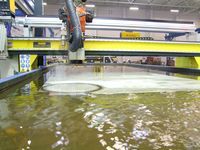
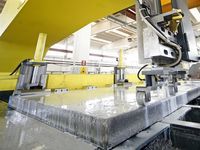
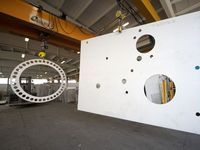
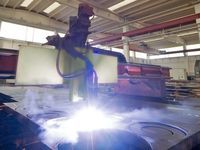
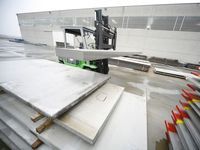
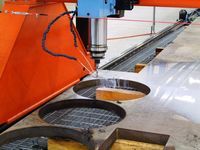
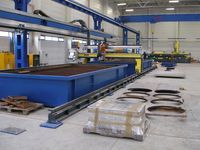
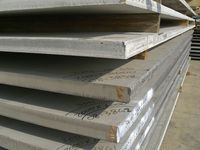
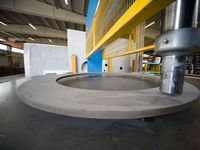
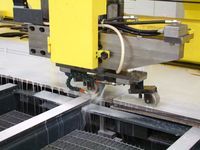
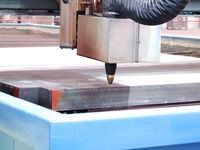
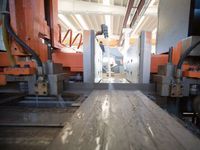
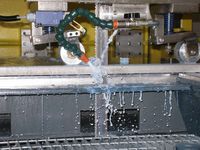
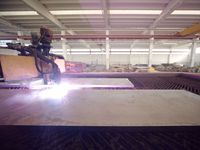
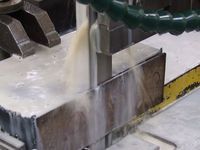
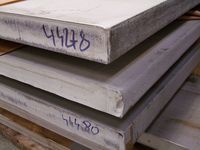
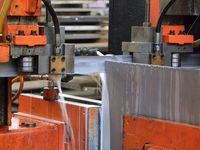
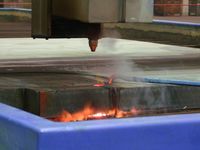
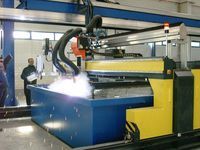
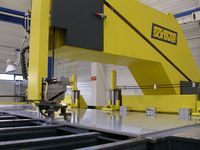
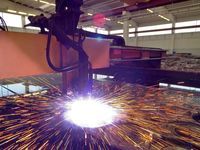
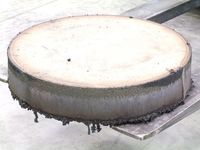
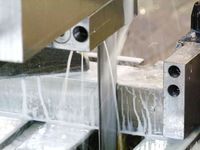
CUTTING TO SIZE AND TRADING
OF STAINLESS STEEL QUARTO PLATES
| Material properties | Chemical composition (according to EN 10088-1:2005) | Mechanical properties at 20°C (according to EN 10088-2:2005) | Physical properties at 20°C (according to EN 10088-1:2005) | ||||||||||||||||||
|---|---|---|---|---|---|---|---|---|---|---|---|---|---|---|---|---|---|---|---|---|---|
| Steel designation | Microstructure | Chemical composition % by mass | For thickness | Tensile strength | Proof strength | Elongation after fracture | Density | Thermal conductivity | Specific thermal capacity | Electrical resistivity | Magnetizable | ||||||||||
| W.nr. | Steel name | ASTM | C max | Si max | Mn max | P max | S max | Cr | Mo | Ni | Other | Rm (Mpa) | Rp0,2 (Mpa) | A (%) | kg/dm³ | W/m·K | J/kg·K | Ω·mm²/m | yes/no | ||
| 1.4000 | X6Cr 13 | 410S | ferritic | 0,08 | 1,00 | 1,00 | 0,040 | 0,015 | 12,0 - 14,0 | - | - | - | max. 25 mm | 400-600 | min. 220 | min. 19 | 7,7 | 30 | 460 | 0,60 | yes |
| 1.4307 | X2CrNi 18-9 | 304L | austenitic | 0,03 | 1,00 | 2,00 | 0,045 | 0,015 | 17,5 - 19,5 | - | 8,0 - 10,5 | N ≤ 0,11 | max. 75 mm | 500-700 | min. 200 | min. 45 | 7,9 | 15 | 500 | 0,73 | no |
| 1.4301 | X5CrNi 18-10 | 304 | austenitic | 0,07 | 1,00 | 2,00 | 0,045 | 0,015 | 17,5 - 19,5 | - | 8,0 - 10,5 | N ≤ 0,11 | max. 75 mm | 520-720 | min. 210 | min. 45 | 7,9 | 15 | 500 | 0,73 | no |
| 1.4541 | X6CrNiTi 18-10 | 321 | austenitic | 0,08 | 1,00 | 2,00 | 0,045 | 0,015 | 17,0 - 19,0 | - | 9,0 - 12,0 | Ti: (5xC ÷ 0,70) | max. 75 mm | 500-700 | min. 200 | min. 40 | 7,9 | 15 | 500 | 0,73 | no |
| 1.4550 | X6CrNiNb 18-10 | 347 | austenitic | 0,08 | 1,00 | 2,00 | 0,045 | 0,015 | 17,0 - 19,0 | - | 9,0 - 12,0 | Nb: (10xC ÷ 1,00) | max. 75 mm | 500-700 | min. 200 | min. 40 | 7,9 | 15 | 500 | 0,73 | no |
| 1.4404 | X2CrNiMo 17-12-2 | 316L | austenitic | 0,03 | 1,00 | 2,00 | 0,045 | 0,015 | 16,5 - 18,5 | 2,00 - 2,50 | 10,0 - 13,0 | N ≤ 0,11 | max. 75 mm | 520-670 | min. 220 | min. 45 | 8,0 | 15 | 500 | 0,75 | no |
| 1.4401 | X5CrNiMo 17-12-2 | 316 | austenitic | 0,07 | 1,00 | 2,00 | 0,045 | 0,015 | 16,5 - 18,5 | 2,00 - 2,50 | 10,0 - 13,0 | N ≤ 0,11 | max. 75 mm | 520-670 | min. 220 | min. 45 | 8,0 | 15 | 500 | 0,75 | no |
| 1.4436 | X3CrNiMo 17-13-3 | 316 | austenitic | 0,05 | 1,00 | 2,00 | 0,045 | 0,015 | 16,5 - 18,5 | 2,00 - 2,50 | 10,5 - 13,5 | N ≤ 0,11 | max. 75 mm | 530-730 | min. 220 | min. 40 | 8,0 | 15 | 500 | 0,75 | no |
| 1.4571 | X6CrNiMoTi 17-12-2 | 316Ti | austenitic | 0,03 | 1,00 | 2,00 | 0,035 | 0,015 | 21,0 - 23,0 | 2,50 - 3,50 | 4,5 - 6,5 | Ti: (5xC ÷ 0,70) | max. 75 mm | 520-670 | min. 220 | min. 40 | 8 | 15 | 500 | 0,75 | no |
| 1.4845 | X8CrNi 25-21 | 310S | austenitic heat-resisting | 0,10 | 1,50 | 2,00 | 0,045 | 0,015 | 24,0 - 26,0 | - | 19,0 - 22,0 | N ≤ 0,11 | max. 75 mm | 500-700 | min. 210 | min. 35 | 7,9 | 15 | 500 | 0,85 | no |
| Material properties | Chemical composition (according to EN 10088-1:2005) | Mechanical properties at 20°C (according to EN 10088-2:2005) | Physical properties at 20°C (according to EN 10088-1:2005) | ||||||||||||||||||
|---|---|---|---|---|---|---|---|---|---|---|---|---|---|---|---|---|---|---|---|---|---|
| Steel designation | Microstructure | Chemical composition % by mass | For thickness | Tensile strength | Proof strength | Elongation after fracture | Density | Thermal conductivity | Specific thermal capacity | Electrical resistivity | Magnetizable | ||||||||||
| W.nr. | Steel name | ASTM | C max | Si max | Mn max | P max | S max | Cr | Mo | Ni | Other | Rm (Mpa) | Rp0,2 (Mpa) | A (%) | kg/dm³ | W/m·K | J/kg·K | Ω·mm²/m | yes/no | ||
| 1.4462 | X2CrNiMoN 22-5-3 | S31803 | austenitio-ferritic | 0,03 | 1,00 | 2,00 | 0,035 | 0,015 | 21,0 - 23,0 | 2,50 - 3,50 | 4,5 - 6,5 | N: (0,10 ÷ 0,22) | max. 75 mm | 640-840 | min. 460 | min. 25 | 7,8 | 15 | 500 | 0,80 | yes |
| 1.4410 | X2CrNiMoN 25-7-4 | S32750 | austenitio-ferritic | 0,03 | 1,00 | 2,00 | 0,035 | 0,015 | 24,0 - 26,0 | 3,0 - 4,50 | 6,0 - 8,0 | N: (0,24 ÷ 0,35) | max. 75 mm | 730-930 | min. 530 | min. 20 | 7,8 | 15 | 500 | 0,80 | yes |
| 1.4501 | X2CrNiMoCuWN 25-7-4 | S32760 | austenitio-ferritic | 0,03 | 1,00 | 1,00 | 0,035 | 0,015 | 24,0 - 26,0 | 3,00 - 4,00 | 6,0 - 8,0 | N: (0,20 ÷ 0,30) | max. 75 mm | 730-930 | min. 530 | min. 25 | 7,8 | 15 | 500 | 0,80 | yes |
| 1.4539 | X1NiCrMoCu 25-20-5 | N08904 | austenitic | 0,02 | 0,70 | 2,00 | 0,03 | 0,01 | 19,0 - 21,0 | 4,00 - 5,00 | 24,0 - 26,0 | N ≤ 0,15 | max. 75 mm | 520-720 | min. 220 | min. 35 | 8 | 12 | 500 | 0,85 | no |
| 1.4547 | X1CrNiMoCuN 20-18-7 | S31254 | austenitic | 0,02 | 0,70 | 1,00 | 0,03 | 0,01 | 19,5 - 20,5 | 6,00 - 7,00 | 17,5 - 18,5 | N: (0,18 ÷ 0,25) | max. 75 mm | 650-850 | min. 300 | min. 40 | 8 | 14 | 500 | 0,85 | no |
Stainless steel material properties and their use
W. Nr. 1.4000 ─ EN: X6Cr13 ─ Alloy 410S ─ UNS S41008
Properties: this material is a low carbon, non–hardening modification of 1.4006, the general purpose 12% chromium martensitic stainless steel. The low carbon and a small alloy addition minimize austenite formation at high temperatures which restricts the alloys ability to harden. The 1.4000 is completely ferritic in the annealed condition. It exhibits adequate corrosion resistance similar to 1.4006 and good oxidation resistance. It resists corrosion in atmospheric conditions, fresh water, mild organic and mineral acids, alkalis and some chemicals. It’s exposure to chlorides in everyday activities (e.g., food preparation, sports activities, etc.) is generally satisfactory when proper cleaning is performed after exposure to use. It can be used in continuous service up to 705°C. Scaling becomes excessive above 811°C in intermittent service. Can be easily formed by spinning, bending and roll forming. Should be machined in the annealed condition using surface speeds of 18.3 – 24.4 m/minute. For maximum corrosion resistance to chemical environments, it is essential that the material surface be free of all heat tint or oxide formed during annealing or hot working. All surfaces must be ground or polished to remove any traces of oxide and surface decarburization. The parts should then be immersed in a warm solution of 10-20% nitric acid followed by a water rinse to remove any residual iron.
Applications: petroleum refining and petrochemical processing (columns, distillation trays, heat exchangers, towers); ore processing (mining machinery); thermal processing (annealing boxes, partitions, quenching racks); gate valves; press plates
W. Nr. 1.4301 ─ EN: X5CrNi18-10 ─ Alloy 304 ─ UNS S30400 and
W. Nr. 1.4307 ─ EN: X2CrNi18-9 ─ Alloy 304L ─ UNS S30403
Properties: it is common for 1.4301 and 1.4307 grades to be stocked in „Dual Certified” form, particularly in plate and pipe. These items have chemical and mechanical properties complying with both specifications. Grade 1.4301 is the standard „18/8” stainless; it is the most versatile and most widely used stainless steel, available in a wider range of products, forms and finishes than any other. It has excellent forming and welding characteristics. The balanced austenitic structure of 1.4301 enables it to be severely deep drawn without intermediate annealing, which has made this grade dominant in the manufacture of drawn stainless parts. Grade 1.4301 also has outstanding welding characteristics. Grade 1.4307, the low carbon version of 1.4301, is used for welded products which might be exposed to conditions which could cause intergranular corrosion in service. This grade does not require post-welding annealing and so is extensively used in heavy gauge components.
Applications: these alloys may be considered for a wide variety of applications where one or more of the following properties are important: resistance to corrosion, prevention of product contamination, resistance to oxidation, ease of fabrication, excellent formability, beauty of appearance, ease of cleaning, high strength with low weight, good strength and toughness at cryogenic temperatures, ready availability of a wide range of product forms. Typical applications include: food processing equipment (particularly in beer brewing, milk processing, wine making); kitchen benches, sinks, troughs, equipment and appliances; architectural panelling, railings&trim; chemical containers (including for transport); heat exchangers; woven or welded screens for mining, quarrying&water filtration; threaded fasteners; springs
W. Nr. 1.4541 ─ EN: X6CrNiTi18-10 ─ Alloy 321 ─ UNS S32100
Properties: grade 1.4541 is stabilized stainless steel which offer as the main advantage an excellent resistance to intergranular corrosion following exposure to temperatures in the chromium carbide precipitation range from 427 to 816°C. This material is stabilized against chromium carbide formation by the addition of titanium. It is also advantageous for high temperature service bacause of the good mechanical properties. This grade offer higher creep and stress rupture properties than 1.4301 and, particularly 1.4307, which might also be considered for exposures where sensitization and intergranular corrosion are concerns.
Applications: typical applications include furnace parts; chemical processing equipments; heating element tubing; heat exchangers; equipment and components in the food industry; film and photo industry; power plant construction; aircraft exhaust manifolds; jet engine parts
W. Nr. 1.4550 ─ EN: X6CrNiNb18-10 ─ Alloy 347 ─ UNS S34700
Properties: this type of stainless steel is an Nb-stabilized Cr-Ni austenitic stainless steel, does not respond to heat treatment. It can be hardened only by cold working. It is reccomended for parts fabricated by welding which cannot be subsequently annealed. Good resistance for continuous service up to approx 850°C and for intermittent service up to 800°C. The addition of Niobium produces a stabilized type of stainless that eliminates carbide precipitation, and consequently, intergranular corrosion. It is superior to general corrosion resistance over type 1.4541. Better high temperature properties than 1.4301 and 1.4307.
Applications: high temperature chemical process; heat exchanger tubes; refineries; high temperature steam service; furnace fire walls; pressure vessels; welded structure and equipment operating at elevated temperatures: gas turbine blades and components for operation in the range 450 to 800°C.
W. Nr. 1.4401 ─ EN: X5CrNiMo17-12-2 ─ Alloy 316 ─ UNS S31600 and
W. Nr. 1.4404 ─ EN: X2CrNiMo17-12-2 ─ Alloy 316L ─ UNS S31603
Properties: the materials 1.4401 and 1.4404 are usually stocked in „Dual Certified” form, particularly in plate, same as 1.4301/1.4307. They are molybdenum-bearing austenitic stainless steels which are more resistant to general corrosion and pitting/crevice corrosion than the conventional chromium-nickel austenitic stainless steels such as 1.4301. Offers higher creep, stress-to-rupture, and tensile strength at elevated temperatures. The 1.4401 and 1.4404 contain 2 to 3% molybdenum in applications requiring enhanced pitting and general corrosion resistance. In addition to excellent corrosion resistance and strength properties, they provide the excellent fabricability and formability which are typical of the austenitic stainless steels.
Applications: the steel 1.4404 shows good acid resistance. It is used in chemical industry; apparatus engineering; sewage plants and paper industry. The steel 1.4401 is mainly used in the chemical industry; creamery; dairy; pulp industry; breweries; sewage plants.
W. Nr. 1.4436 ─ EN: X3CrNiMo17-13-3 ─ Alloy 316 ─ UNS S31600
Properties: stainless austenitic, chromium nickel molybdenum steel. It is slightly more resistant to corrosion than 1.4401, especially in chloride containing environments, due to the slightly higher molybdenum addition. Displays excellent resistance to corrosion in most natural waters (urban, rural and industrial), even at moderate chloride and salt contents. In the food, beverage and agricultural sectors, 1.4436 displays excellent corrosion properties. This grade of stainless steel is also resistant to corrosion in various acid environments. Due to its relatively high carbon content, 1.4436 is not considered to be resistant to intergranular corrosion in the welded condition. Despite this, thin sections may be welded without the danger of intergranular corrosion. Is not resistant to sea water.
Applications: food preparation equipment particularly in chloride environments; laboratory benches and equipment; coastal architectural panelling, railings and trim; chemical containers; heat exchangers
W. Nr. 1.4571 ─ EN: X6CrNiMoTi17-12-2 ─ Alloy 316Ti ─ UNS S31635
Properties: it is an improved corrosion resistant chrome-nickel steel alloy with high content of molybdenum and some titanium. It is not a typical free machining grade and therefore not recommended for difficult high speed machining process. This grade is essentially a standard carbon 316 type with titanium stabilisation and is similar in principle to the titanium stabilisation of the 304 (1.4301) type to produce 321 (1.4541). The addition of titanium is made to reduce the risk of intergranular corrosion (IC) following heating in the temperature range 425-815°C. Due to its superior Corrosion resistance, it has been used in handling many of the chemicals used by chemical process industries. It is more resistant to pitting Corrosion than typical 18-8 alloys for optimum corrosion resistance, surface must be free of scales and foreign particles. Parts should be passivated.
The titanium stabilised 1.4571 grade may also be prone to 'knife line attack' in the heat-affected zones of welds, very close to the fusion zone where the carbo-nitrides have redissolved in the solid steel matrix.
Applications: it is mainly used in the chemical industry, textile industry, cellulose industry, pharmaceutical industry, water management; buildin cladding, doors, windows and fittings; offshore modules; tanks and tubes/pipes for chemical tankers; storage and overland transportation of chemicals, food and beverages; pharmaceutical, synthetic fiber, pressure vessels.
W. Nr. 1.4845 ─ EN: X8CrNi25-21 ─ Alloy 310S─ UNS S31008
Properties: austenitic heat-resisting alloy with excellent resistance to oxidation, standardised as high-temperature steel for use at temperatures of up to 1100ºC in dry air. Its high chromium and nickel contents provide comparable corrosion resistance, superior resistance to oxidation and the retention of a larger fraction of room temperature strength than the common austenitic grades.
Applications: it is commonly used in oven linings, boiler baffles, kilns, lead pots, radiant tubes, annealing covers, saggers, burners, combustion tubes, refractory anchor bolts, fire box sheets, furnace components and other high temperature containers.
W. Nr. 1.4462 ─ EN: X2CrNiMoN22-5-3 ─ UNS S31803
Properties: the austenitic special steel 1.4462 has an austenitic-ferritic microstructure in which both microstructure components are present in approximatelly equal amounts. Duplex stainless steel is characterised by high chromium and molybdenum and lower nickel contents than austenitic stainless steels. it is designed to combine improved resistance to stress corrosion cracking, pitting, crevice corrosion and high strength when compared with other stainless alloys. With its composition, duplex stainless steel resists chloride environments and sulphide stress corrosion.
Applications: due to its favorable mechanical properties, together with high resistance to corrosion, this material has many applications, such as: chemical industry, petrochemical industry, offshore, sea water piping, sea water desalination plants, nuclear technology, paper and cellulose production.
W. Nr. 1.4410 ─ EN: X2CrNiMoN25-7-4 ─ UNS S32750
Properties: high alloy duplex stainless steel for service in highly corrosive conditions. The material is described as a super duplex stainless steel with a microstructure of 50:50 austenite and ferrite. The steel combines high mechanical strength and good ductility with outstanding corrosion resistance in marine environments. The material offers high resistance to crevice corrosion, pitting corrosion and stress corrosion cracking. Ambient and subzero (down to minus 50°C) notch ductility is good. These attributes mean that this super duplex steel can be used succesfully as an alternative to 300 series stainless steel, standarad 22% Cr duplex steel and precipitation hardening stainless steel.
Applications: this material is specially designed for service in aggressive chloride-containing environments. Typical applications are: oil and gas industry, seawater cooling, salt evaporation industry, desalination plants, geothermal wells, refineries and petrochemical plants, mechanical components requiring high strength, pulp and paper industry.
W. Nr. 1.4501 ─ EN: X2CrNiMoCuWN25-7-4 ─ UNS S32760
Properties: austenitic-ferritic stainless steel, the most common super duplex grade. Has excellent corrosion resistance to a wide variety of media, with outstanding resistance to pitting and crevice corrosion in seawater containing environments, with Critical Pitting Temperature exceeding 50°C. Resists better than Cr-Ni austenic grades also in chloride environments, especially under mechanical stress. Best results are obtained in the solution treated condition. Maximum service temperature is 300°C. It is not recommended for welded structures, because tougheness and corrosion resistance in the weld heat affected material are heavily decreased.
Applications: : providing higher strength than both austenitic and duplex stainless steels, is suited to a variety of applications in industries such as chemical processing, oil&gas, marine environments. Its good mechanical and corrosion resistance properties, a result of a duplex microstructure, make it useful for parts subject to stress corrosive attack: valve parts, pumps, centrifugal machines.
W. Nr. 1.4539 ─ EN: X1NiCrMoCu25-20-5 ─ UNS N08904
Properties: austenitic special steel with high molybdenum content as well as addition of copper and extremely low carbon content. It is a multipurpose high corrosion resistant stainless steel, particularly useful in sulphuric acid applications, in phosphoric acid environments. Performance in phosphoric acid is strongly influenced by the level of impurities present. The material also has useful resistance to organic acids such as formic and oxalic acids. With respect to localised corrosion, the high nickel content makes it more resistant to stress corrosion cracking than other common austenitic stainless steel whilst the levels of chromium, molybdenum and nitrogen impart excellent resistance to pitting and crevice corrosion.
Applications: the chromium, nickel, molybdenum and copper content of the alloy renders it suitable for many applications dealing with medium to corrosive environments: offshore; sea water technology; chemical industry; good stability against reducing acids of medium strength like sulphuric acid and phosphoric acid and various chloric media, paper industry, pulp industry.
W. Nr. 1.4547 ─ EN: X1CrNiMoCuN20-18-7 ─ UNS S31254
Properties: austenitic chromium-nickel-molybdenium stainless steel with excellent resistance to stress corrosion cracking, pitting and crevice corrosion. Resistant to intergranular corrosion in the temperature range up to 400 °C. For optimum resistance, surface should be pickled, scalefree heat treated or machined.
Alkalmazás: for applications involving highly corrosive environments due to the presence of chemically aggressive media, e.g. for equipment and plants which are cooled by sea-water and parts for offshore plants. In the chemical industry where resistance to the attack of pure acids as well as acids containing chloride ions (sulphuric acid in particular), of organic acids and mixed acids is required in the higher pressure and temperature ranges. The enhanced resistance to crevice corrosion permits use also for applications where incrustation must be expected, and/or where the formation of gaps cannot be avoided by design precautions.